Common pitfalls in ACLS certification exam: tips & guidance
Ahmed Raza
 Reviewed by Jessica Munoz DNP, RN, CEN
Changes: Article reviewed and updated by Jessica Munoz
The following are the most common mistakes students make on their ACLS test. We compiled them together to make studying easier for you.
Hands-free pads vs paddles
Cardiac defibrillation (a V-fib treatment) is the delivery of a transthoracic electrical current to a person experiencing ventricular fibrillation (VF).1 Electrical defibrillation is the ultimate treatment for VF, which involves the use of hands-free defibrillation pads or defibrillation paddles. Hands-free pads are preferred over paddles due to their potential benefits and efficiency. They allow more rapid defibrillation than defibrillation paddles. Another reason for this preference is that they deliver more energy. The placement of both is the same, typically in an anterior-lateral configuration (anteroposterior is an acceptable alternative). Self-adhesive pads significantly reduce interruption time for the safe delivery of shock during patient resuscitation. Decreasing interruptions between cardiac compressions increases the patient’s survival rate. The hands-free pads are thus preferred over defibrillation paddles due to their ease of use and efficacy, as they enable rapid defibrillation and deliver more energy, ultimately increasing the success rate of shock delivery.2
Placement of defibrillation pads
To restore normal sinus rhythm in a patient with ventricular fibrillation arrest, timely defibrillation is important. Defibrillation involves the use of hands-free pads or paddles. The standard placement is that the apex (lateral) electrode/pad should be placed ‘along the mid-axillary line at the level of the 5th–6th intercostal space’ and the sternal (anterior) electrode/pad should be placed ‘below the clavicle just to the right of the upper sternal border’.3 Another acceptable position is to place the paddle (labeled “sternum”) in the infrascapular location, i.e., posterior to the heart, and to place the “apex” paddle anterior, over the left precordium. Anterior-lateral placement is standard; anterior-posterior placement is an acceptable alternative in certain situations. However, if there is a risk of overlapping in defibrillation electrodes (pediatric patients), anterior-posterior electrode placement may be considered.4 Keep the electrodes separated and take care that the gel or the paste applied on the chest is not smeared between paddles; in this case, the current can follow a superficial pathway, thus missing the heart. Sticky defibrillator pads are effective for this purpose and can be placed at any of these locations.
Determine the correct size of a King Airway
King Airway is 100% latex-free and includes a sterile cover for single-patient use. It can pass a gastric tube through a second channel into the stomach. The device is unlikely to enter the trachea.5 The correct size is chosen on the basis of the patient’s height. One should observe the patient’s height to determine the correct size of a King Airway. There are multiple sizes, each ideal for a person with a particular height range. Observing the patient’s height would indicate the correct size of the King Airway to select.
When is cardioversion needed?
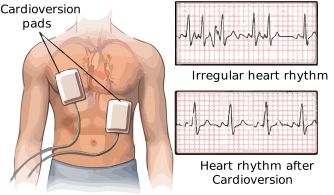
Cardioversion converts an abnormal, potentially dangerous heart rhythm into a normal sinus rhythm. Unstable tachyarrhythmias require cardioversion.6 Cardioversion is also used in critical situations for people who suffer sudden life-threatening arrhythmias. Cardioversion is usually used as a treatment for people with atrial flutter or atrial fibrillation. For hemodynamic deterioration caused by unstable ventricular tachycardia, emergency electrical cardioversion is performed. Hemodynamically unstable ventricular tachycardia (VT) requires prompt termination with synchronized cardioversion.7 When vagotonic maneuvers and antiarrhythmic treatments remain unsuccessful for sustained supraventricular tachycardia (diagnosed after supraventricular tachycardia ECG), electrical cardioversion should be the next step. Electric cardioversion can help the doctors see instantly if the procedure has restored a normal heartbeat; it takes less time than cardioversion done solely with medications.8 Immediate electrical cardioversion should be considered if the patient is hypotensive, has an altered mental status, chest pain, or heart failure.
DNR
A do-not-resuscitate (DNR) order is a medical order written by a doctor.9 It instructs that if the patient’s heart stops beating or if the patient’s breathing stops, healthcare providers should not perform cardiopulmonary resuscitation (CPR). Standard in-hospital DNR orders may not be valid outside the hospital; out-of-hospital DNR forms or POLST are typically required. The only valid way to communicate the desire not to be resuscitated is to utilize a special out-of-hospital DNR (each state has a different form) that is especially approved for use outside of the hospital.
Routine administration of high-flow oxygen after ROSC
As per the recent studies, high oxygen concentrations are used during CPR; after ROSC, oxygen should be titrated to avoid hyperoxemia.10 Hyperoxemia has caused controversial results in humans. Brain injury is reduced by administering high FiO2 promptly after return of spontaneous circulation (ROSC).11 Some studies conclude that hyperoxemia may potentially aggravate or intensify brain injury after experimental cardiac arrest. Thus, it is no longer recommended to routinely administer FiO2 of 100% after CPR.
To clarify other confusions regarding ACLS course exam checkout ACLS algorithms.
References
- https://www.ncbi.nlm.nih.gov/books/NBK499899/
- https://pmc.ncbi.nlm.nih.gov/articles/PMC5523087/
- Defibrillation guidelines
- https://www.nhlbi.nih.gov/health/defibrillators
- https://www.dhs.wisconsin.gov/ems/training/ktlsd-curriculum.pdf
- https://www.ncbi.nlm.nih.gov/books/NBK470536/
- https://www.ahajournals.org/doi/10.1161/circ.102.suppl_1.I-112
- https://www.mayoclinic.org/tests-procedures/cardioversion/about/pac-20385123
- https://medlineplus.gov/ency/patientinstructions/000473.htm
- https://pmc.ncbi.nlm.nih.gov/articles/PMC5052921/
- https://pmc.ncbi.nlm.nih.gov/articles/PMC4847238/
How we reviewed this article
Our experts continually monitor the medical science space, and we update our articles when new information becomes available.
- Current versionMail the author of this pageEmail
- Apr 12, 2026
Reviewed by:
Changes: Article reviewed and updated by Jessica Munoz